

I first looked at ZhongAn Online back at its IPO in 2017, and I did what most disciplined investors did back then: I passed. The stock came public at HK$59.70, ran to almost HK$98 within days, and was valued as though it had already conquered global insurance. It hadn’t. It was losing money on every policy it wrote.
What followed was one of the more brutal de-ratings I have watched in Asia. Today the share sits around HK$9.50 — roughly 90% below the all-time high, near the lowest level it has ever traded, with a market capitalisation of about HK$16bn (~US$2bn). Meanwhile net assets at the end of 2025 stood at RMB 25.4bn, or roughly HK$16.60 per share. Read that twice: the market is currently paying around 0.57 times book for a company that has now delivered five consecutive years of underwriting profit and just tripled its adjusted earnings.
That is the setup that makes me interested. Not a story stock. A cheap, misunderstood, structurally advantaged financial that the market has decided to file under “China risk, forget it.”
My thesis in one paragraph: ZhongAn has quietly completed the transition every insurtech promises and almost none delivers — from growth-at-any-cost premium accumulation to disciplined underwriting. The combined ratio has gone from a disastrous 133% in the loss-making years to 95.8% in 2025. The health ecosystem is compounding above 20% with a 92% combined ratio. ZA Bank, the digital bank nobody believed would ever make money, turned its first full-year profit. And the drag on reported earnings — the consumer-finance book — is being deliberately shrunk by management, which depresses 2026 optics while improving the quality of everything underneath. On my Fair PE framework I arrive at a fair P/E of 21 and a potential return of roughly 32% per annum over three years. ZhongAn is a position in the Haas Invest4 Innovation Fund.
Let me walk you through it properly.
1. Product, business model, brand and moat
What the company actually does. ZhongAn was founded in October 2013 in Shanghai as China’s first fully online property & casualty insurer. No branches. No agents. No paper. Every policy is sold, underwritten, serviced and paid out through an app, a mini-programme or an API embedded in someone else’s platform. It became the first fintech listed on the Hong Kong Stock Exchange in September 2017.
The business is organised into four insurance ecosystems plus two adjacent businesses:
Health — the crown jewel. FY2025 gross written premiums of RMB 12.68bn, up 22.7%, at a combined ratio of 92.1%, a 3.6 point improvement. The flagship “Personal Clinic Policy” (尊享e生) million-yuan medical product has now been through more than 25 iterations in a decade. Alongside it sits “Zhong Min Bao,” a deliberately inclusive line covering pre-existing conditions, the elderly and chronic patients — a segment traditional Chinese insurers have historically refused to touch.
Digital lifestyle — the original business. Return-shipping insurance sold through e-commerce, plus pet, flight delay, travel and cancellation cover. Still the largest premium pool at RMB 15.97bn, but it shrank 1.4% in 2025 at a combined ratio of 99.9%. In plain language: this segment now contributes scale and data, not profit.
Auto — the fastest-improving line. Insurance service revenue of RMB 2.37bn, up 28.4%, combined ratio 93.1%. Family cars make up 87.9% of auto premiums, and NEV insurance is growing rapidly off a small base. ZhongAn secured independent operation of compulsory traffic insurance in Shanghai and Zhejiang in December 2024 — a genuine regulatory unlock.
Consumer finance — credit guarantee insurance for online lenders. This is being wound down on purpose. FY2025 premiums of RMB 4.3bn, down year-on-year; the outstanding loan balance has been falling from RMB 27.7bn. Management guides to a 50–60% decline in 2026 and further contraction into 2027/2028.
Technology — selling ZhongAn’s core insurance systems, AI and blockchain stack to other insurers domestically and across Asia. Still loss-making, but losses have narrowed sharply.
Banking — ZA Bank in Hong Kong, held via ZA Global. More on this below, because I think it is the single most underappreciated asset on the balance sheet.
How they make money. Two engines, exactly as Buffett taught us to look at insurers. First, underwriting profit: premiums earned minus claims minus expenses. In 2025 that was RMB 1.41bn, up 42.5%, from a combined ratio of 95.8% — 57.1% loss ratio, 38.7% expense ratio. Second, investment income on the float: total investment income rose 59.1% in 2025 as Chinese capital markets recovered. Together those produced adjusted net profit attributable to shareholders of RMB 1.80bn, up 198.3%.
That combined ratio number deserves emphasis because it is the whole investment case in a single metric. An insurer running above 100% is paying for the privilege of holding your money. An insurer running at 95.8% is being paid to hold it, and then earns a return on it as well. ZhongAn crossed that line and has stayed on the right side of it for five straight years.
Brand. ZhongAn is now the 8th largest P&C insurer in China by gross written premiums, and it is gaining share. That is remarkable for a company with zero physical distribution competing against giants like PICC and Ping An. The brand strength is concentrated where it matters: young, digitally native customers who will never walk into a branch, and who ZhongAn acquires at a fraction of the cost of an agent-led insurer. Proprietary direct-to-consumer channels now generate over a fifth of total premiums, and that share is climbing — which matters enormously, because D2C premiums carry far better economics than premiums acquired through a platform partner taking a cut.
The brand is not spotless. There are more than 20,000 complaints on China’s Heimao consumer platform, clustered around “first month RMB 0” and “first month RMB 1” promotional pricing with automatic renewal — customers feel they were enrolled into recurring charges they did not fully understand. A pet insurance advertisement in May 2026 drew public criticism for tasteless imagery. Neither is existential, but I track them, because in Chinese financial services regulatory patience with consumer-conduct issues is finite.
Moat. This is where I push back on the lazy bear case that “insurance is a commodity, anyone can copy it.” Three things are genuinely hard to replicate:
Cost structure. ZhongAn’s expense ratio reflects a business with no branch network, no agent commissions and no legacy IT. Every point of expense advantage flows straight into either margin or price competitiveness. A legacy insurer cannot simply decide to have this — it would have to dismantle its distribution.
Embedded distribution. ZhongAn sits inside the checkout flow of e-commerce platforms, travel apps, telecom carriers and lending platforms. The insurance is invisible; it is a checkbox. Winning that integration requires the API, the underwriting speed and the regulatory licence simultaneously.
Data and claims automation. This is not a slide-deck claim. In auto, 88.2% of claims are now self-reported online, over half are handled through instant video assessment using NFC “tap-to-report,” AI damage assessment runs as fast as 116 seconds, and claims under RMB 10,000 settle in about 13.3 minutes. The in-house AI platform “Lingxi” runs a growing fleet of agents across the entire insurance value chain. In a business where claims handling is the largest cost line and the primary driver of churn, this is a durable operating advantage.
Where the moat is thinnest is digital lifestyle. Return-shipping insurance is close to a commodity, priced razor-thin, and its 99.9% combined ratio proves it. I do not underwrite this position on that segment.
2. The market
Chinese property & casualty insurance is enormous and still structurally underpenetrated relative to developed markets. Insurance density and penetration in China remain well below the US, Japan or Germany, and the gap closes as household wealth and consumption grow. Within that, the two sub-markets ZhongAn is levered to are the attractive ones.
Health insurance is the standout. China’s public healthcare system covers a basic floor; anything beyond it — imported drugs, private wards, cancer therapies, medical devices — is out of pocket. Commercial health insurance fills that gap and grows structurally faster than GDP as the population ages and as healthcare payment reform pushes more cost onto private cover. ZhongAn’s 22.7% growth here is not a share-grab; it is riding a genuine expansion.
Pet insurance is a smaller but explosive adjacency. Chinese dog and cat household penetration sits in the high teens and is climbing, and it remains roughly half the level of Japan or Thailand — countries with comparable urban living conditions. Pet insurance in China is where pet insurance in Japan was fifteen years ago.
NEV auto insurance is the third leg. China dominates global electric vehicle production, NEVs are taking an ever-larger share of the domestic fleet, and NEV policies carry higher premiums than combustion equivalents. ZhongAn has an early, growing position.
Political intervention. I will not sugar-coat this. Insurance in China is a licensed, closely supervised industry, and Beijing intervenes. The “报行合一” reform — forcing insurers to charge what they file with the regulator — compressed distribution expenses across the entire industry. That happened to help ZhongAn (its auto expense ratio fell 2.8 points), but it demonstrates that pricing is not fully in management’s hands. Consumer-finance and credit-guarantee insurance have been under sustained regulatory scrutiny for years. And the Hong Kong listing means the shares are hostage to the broader geopolitical mood in a way the underlying business is not.
Cyclicality. The old argument that “insurance is defensive because people insure regardless of the economy” is only half right for ZhongAn, and I want to be honest about that. Health and auto premiums are genuinely resilient. But return-shipping insurance is tied directly to e-commerce volumes, credit-guarantee insurance is tied to consumer credit quality, and — critically — a large share of earnings comes from investment income on the float, which is tied to Chinese equity and bond markets. The 2025 profit explosion was partly an underwriting story and substantially a market story. Investors who model ZhongAn as a bond-like defensive will be surprised in both directions.
3. Culture and management
ZhongAn’s founding story is legendary and, frankly, over-told. It was launched in 2013 with backing from Jack Ma’s Alibaba/Ant, Pony Ma’s Tencent and Ma Mingzhe’s Ping An — “the three Mas.” It was the first insurance licence in China granted to a purely online entity, and that pedigree is genuinely what made the venture possible.
But the ownership picture today is very different, and anyone still buying this stock for the “three Mas” narrative is buying a memory. Over the past several years the original strategic holders have materially reduced their positions. In 2026, founding shareholder Ou Yaping consolidated family holdings and returned as the single largest shareholder with roughly 11.94%, ahead of Ping An at around 8.90%. The centre of gravity has shifted from a consortium of Chinese tech champions to a founder-anchored ownership structure.
I regard that as a net positive, with a caveat. The positive: founder-led companies with concentrated skin in the game make better long-term capital allocation decisions than committee-governed joint ventures, and this is exactly the profile I look for. The caveat: the strategic distribution advantages that came bundled with Alibaba and Tencent ownership are no longer guaranteed by shareholder alignment — ZhongAn must now win that shelf space commercially, every year.
On the entrepreneurial dimension, management has earned my respect in a specific and unglamorous way: they have shown willingness to shrink. Voluntarily cutting a profitable-looking premium line by 50–60% because the risk-adjusted returns are not good enough is the single hardest thing to do in insurance, where every incentive pushes toward writing more. The consumer-finance runoff will make 2026 headline growth look mediocre. They are doing it anyway. That is long-term thinking.
The same is true of ZA Bank. Building Hong Kong’s first virtual bank meant absorbing years of losses to reach the scale where a digital bank’s unit economics finally work. In 2025 it worked: net revenue up 62.7%, cost-to-income ratio down 32 percentage points, and the first full-year net profit in the bank’s history. That is what patient capital deployment looks like.
Balance sheet discipline is intact: comprehensive solvency ratio of 242% at end-2025 and 241% at the end of Q1 2026. Moody’s rates the insurance financial strength Baa1 with a positive outlook, and AM Best affirmed A- (Excellent) and revised its outlook to positive in November 2025. Two independent rating agencies moving in the same direction, while the equity market moves the other way, is precisely the kind of divergence I hunt for.
4. Financials and recent developments
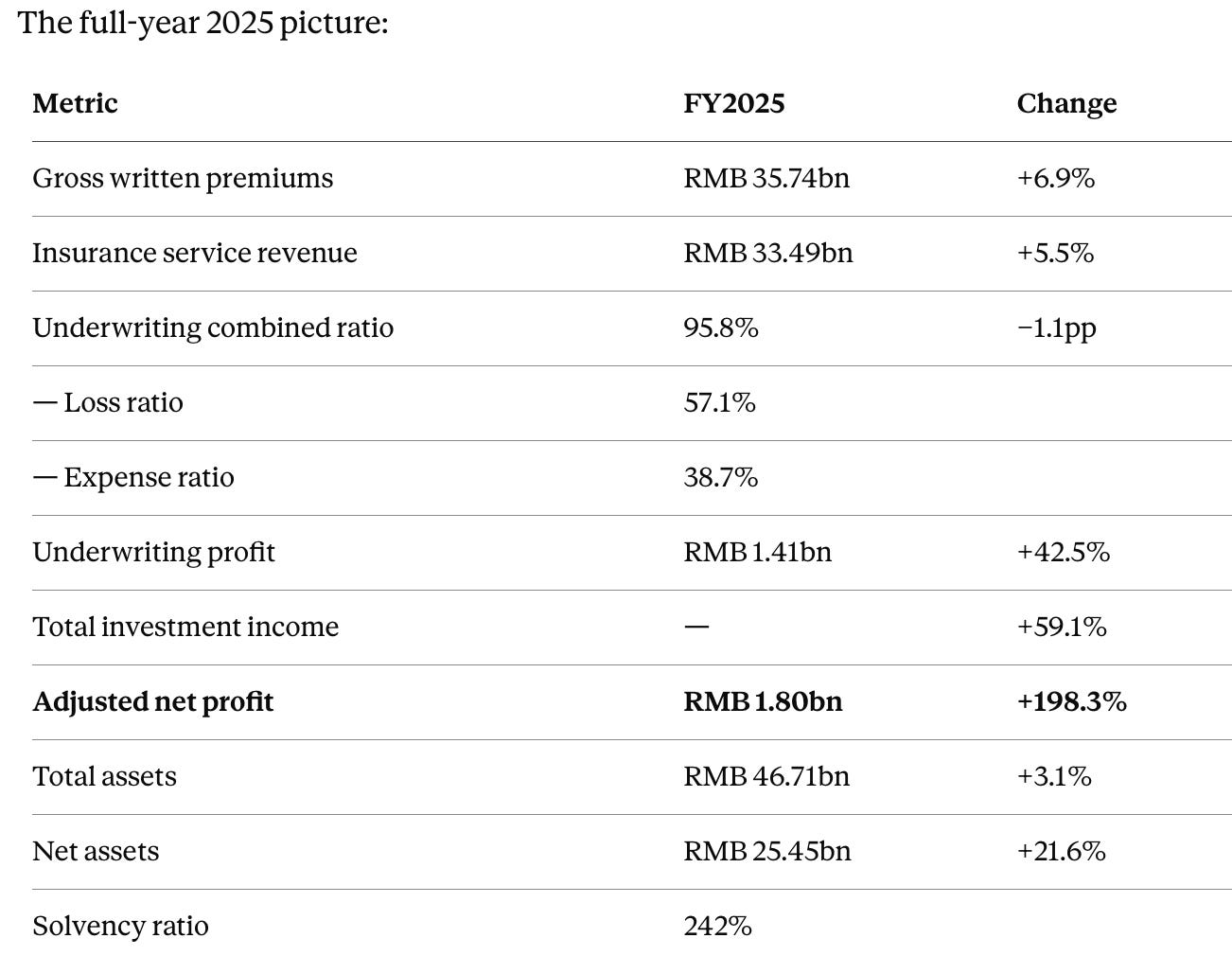
Reported net profit came in around RMB 1.10bn — the gap to the adjusted figure is largely a one-off, non-cash impairment of roughly RMB 750m at ZA Global, the international arm. I use the adjusted number for the earnings power discussion and the reported number for the P/E screens, and investors should be aware that many data providers show only one of the two, which is part of why this stock screens inconsistently.
Margins. Let me be precise, because insurance margins are routinely misread. Net income margin on insurance service revenue was roughly 3.3% reported / 5.4% adjusted in 2025. That sounds thin next to a software company, and it is — but it is normal for P&C, where revenue is gross premium flow, not value-added. Return on equity on the 2025 adjusted result was approximately 7–8%, up sharply from near-zero in 2024, and still well below what this business should earn. EBITDA is not a metric I use for insurers or banks and I would encourage readers to ignore it here entirely; combined ratio, ROE and solvency are the numbers that matter.
The problem: Q1 2026. This is why the stock is where it is. First-quarter insurance business income was RMB 7.93bn, but net profit collapsed to RMB 171m, down 69.9% year-on-year from RMB 569m. Net assets were essentially flat at RMB 25.29bn. The market read that as the 2025 recovery unravelling.
I read it differently, and this is the crux of my thesis. Q1 2025 benefited from an exceptionally strong investment result; Q1 2026 did not. Simultaneously, the consumer-finance runoff was hitting premium and fee income while the fixed cost base had not yet adjusted. The underwriting engine — which is what I am actually buying — did not break. But quarterly earnings for an insurer with a large investment portfolio are noisy by construction, and the market punished the noise as though it were signal.
At the April 2026 briefing, management guided 2026 as follows: excluding consumer finance, total premium growth above 10%; auto around +30%; health above 10%; digital lifestyle low double-digit; consumer finance down 50–60%. Sell-side reacted in both directions — Huatai cut FY2026/27 EPS estimates to RMB 0.75 and RMB 0.84 and trimmed its target to HK$23, while Guosen and BofA raised their forecasts. Consensus across roughly fourteen analysts remains a Buy with an average target near HK$20.
One more recent development worth noting: ZhongAn has taken a stake in an offline insurance agency, which reads to me as an acceleration of the auto push. Pure-online distribution has limits in motor insurance, where local presence still matters for acquisition and claims. If that is the reasoning, it is pragmatic rather than dogmatic — and I prefer pragmatic.
5. Valuation: the Fair PE
Here is how I think about what this company is worth.
I do not value ZhongAn on trailing reported earnings, because 2025 contained an unusual investment tailwind and a one-off impairment, and 2026 contains a deliberate, self-inflicted revenue reduction. Both distort the picture in opposite directions. I value it on a normalised earnings base three years out, applying my Fair PE multiple.
The Fair PE for ZhongAn is 21.
Why 21 and not higher or lower? On the positive side: structural growth in the underlying markets, a genuine and widening cost moat, five years of underwriting profitability, a founder-anchored owner, and an underappreciated banking asset. Against that: Hong Kong listing risk, regulatory exposure, an earnings stream partially dependent on Chinese capital markets, a dilution track record, and a low-margin segment that still accounts for the largest share of premiums. A US or European insurtech with these operating characteristics would carry 25–30x. A generic Chinese P&C insurer would carry 8–10x. Twenty-one reflects the quality without pretending the geography and the volatility are free.
The earnings bridge. Working from an FY2026 base of roughly RMB 0.75 per share, I assume: health compounding in the high teens to low twenties; auto growing around 30% off a small base with a combined ratio in the low nineties; digital lifestyle flat-to-modest and margin-neutral; the consumer-finance drag fully absorbed by 2027 and gone by 2028; the technology segment reaching breakeven; and ZA Bank contributing a growing, no-longer-negative earnings line. I deliberately assume no repeat of the 2025 investment income windfall — a normalised, unremarkable investment return.
That produces a normalised FY2028 EPS of approximately RMB 0.95, or about HK$1.05.
Fair PE 21 × HK$1.05 = fair value of approximately HK$22 per share.
Against the current price of about HK$9.50, that is roughly 130% total upside, or about 32% per annum over three years.
Sensitivity, because a single point estimate is dishonest:
Bear case — consumer-finance runoff overshoots, health growth halves under competition, investment returns stay poor: normalised EPS around RMB 0.60 (HK$0.66), fair value ~HK$14, still roughly 13% per annum from here. The downside is protected by book value, not by hope.
Base case — as above: ~32% per annum.
Bull case — health sustains 20%+, auto scales to a genuine third profit engine, ZA Bank re-rates independently, investment returns normalise upward: EPS around RMB 1.30 (HK$1.43), fair value ~HK$30, or roughly 47% per annum.
The sum-of-the-parts cross-check. This is the part that made me size the position rather than just watch it. ZA Bank — Hong Kong’s first and largest digital bank, now profitable — has been valued by at least one sell-side house at around US$2bn. ZhongAn’s economic interest of roughly 43% is therefore worth in the order of US$0.9bn, or close to HK$7bn. Against a total market capitalisation near HK$16bn, that single stake accounts for more than 40% of the entire company’s value.
Strip it out and the core insurance business — the 8th largest P&C insurer in China, growing health premiums above 20%, writing at a 95.8% combined ratio — is being valued at roughly 0.3–0.4 times book. Listed Chinese P&C peers trade around 1.2 times book. I have run a lot of sum-of-the-parts analyses over the years and rarely found a gap this wide on a business that is actually profitable.
6. Risks: why is it this cheap?
A stock does not fall 90% from its high and 55% in a year by accident. I owe you a clear account of what the market is worried about, because if I cannot articulate the bear case better than the bears, I have no business owning the shares.
The stablecoin round trip. In mid-2025, Hong Kong passed its Stablecoin Ordinance. ZA Bank was the first digital bank in Hong Kong to offer reserve banking services to stablecoin issuers, and ZA Global led a US$40m financing round in stablecoin infrastructure firm RD Technologies. The stock ripped — up more than 40% in a month, then more than 70% at the peak. Management, sensibly, issued equity into that strength. Then ZhongAn did not receive a stablecoin issuer licence, the narrative evaporated, and the shares gave back everything and more. Investors who bought the story and the placement are deeply underwater and, understandably, angry. That overhang of disappointed shareholders is real and it takes time to clear.
The Q1 2026 earnings shock. A 70% year-on-year profit decline is the kind of headline that triggers systematic selling regardless of the underlying explanation. Many holders never got past the number.
Deliberate shrinkage looks like decline. When a company guides one of its four segments down 50–60%, screens flag it as a business in trouble. Distinguishing “shrinking because it must” from “shrinking because it chose to” requires reading the transcripts. Most of the market does not.
The largest segment earns nothing. Digital lifestyle is 45% of premiums at a 99.9% combined ratio. Every bear note leads with this, and the point is fair: if return-shipping insurance keeps contracting industry-wide, ZhongAn loses scale and data without losing much profit — but the optics are ugly and the growth rate suffers.
Dilution. A 13% dilution executed near a speculative high, followed by a halving of the share price, is not something shareholders forget quickly. If capital needs recur, the market will assume more of the same.
China and Hong Kong risk. Currency, geopolitics, regulatory intervention, the persistent valuation discount applied to Hong Kong-listed Chinese financials. Ownership changes at the top of the shareholder register add uncertainty about strategic direction. And the auditor transition, while probably routine, is one more thing for a nervous market to fixate on.
Investment income dependence. If Chinese equity markets are flat or down for two years, a meaningful chunk of earnings simply is not there, regardless of how well the underwriting performs.
Where does the opportunity come from, then? From the gap between what is actually deteriorating (one deliberately-shrunk segment, one quarter of weak investment returns, one failed narrative) and what the price implies (that the whole enterprise is worth less than its accounting equity). Markets are very good at pricing direction and very bad at pricing the difference between temporary and permanent. That is the entire game.
7. Latest news and the upcoming catalyst
The near-term calendar is unusually well-defined, which is rare and useful.
ZhongAn’s board meets on 25 August 2026 to approve interim results for the six months to 30 June 2026 — and, notably, to consider the recommendation of an interim dividend. That second item is the one I would flag hardest. ZhongAn has never paid a dividend. It has been building capital, absorbing losses at ZA Bank and the technology arm, and reinvesting. The mere fact that a dividend is on the agenda signals a company that believes it has passed peak capital intensity. Whether or not they declare one, the discussion itself is a change of posture.
What I will be watching in those numbers, in order of importance:
Combined ratio. Does it hold below 96%? Comparison base is 95.6% in H1 2025. Anything at or below that confirms the underwriting engine is intact and Q1’s weakness was investment-driven.
Health ecosystem growth and its combined ratio. This is the quality engine. I want to see continued double-digit growth at or below 92%.
Auto. Guidance was +30%. Delivery would establish auto as a credible third profit centre.
The consumer-finance runoff pace. Faster is better, even though it hurts the headline.
ZA Bank’s contribution. It made HK$49m in H1 2025 before finishing the full year with a much slimmer profit. I want to see H1 2026 profitability sustained, not lumpy.
Technology segment losses. Narrowing losses here are pure incremental earnings — the R&D is already spent.
Other developments in the current news flow: the shareholder restructuring that returned the founder to the top of the register; the auditor change to Deloitte; the offline agency stake supporting the auto expansion; and continued build-out of the AI infrastructure across claims and underwriting. Sentiment on Chinese fintech Twitter and in the Hong Kong retail community remains poor — the recurring phrase in shareholder forums is that the company “lost the wife and the army” on the stablecoin adventure. When retail sentiment is that sour on a profitable company trading at 0.57x book, I pay attention rather than agree.
8. Conclusion
Let me return to where I started. In 2017 ZhongAn was a fantastic story attached to a terrible business at an absurd price. In 2026 it is a mediocre story attached to a genuinely improved business at a very cheap price. I would take the second combination every single time, because stories re-rate and businesses compound, but you only get paid for both when the entry price is wrong.
The three investment cases I see, in ascending order of ambition:
The value case. You are buying an insurer at roughly 0.57 times book with a 242% solvency ratio, positive rating agency momentum from both Moody’s and AM Best, five consecutive years of underwriting profit, and a bank stake worth over 40% of the market capitalisation. Even if ZhongAn never grows again, a re-rating to book value alone is roughly 75% upside. This is the floor, and it is a reasonably hard one.
The normalisation case — my base case. The consumer-finance drag rolls off by 2028. Health and auto do what management has guided. Technology reaches breakeven. Investment returns are merely average rather than exceptional. Normalised EPS reaches around RMB 0.95, the market applies my Fair PE of 21, and the share reaches roughly HK$22. That is approximately 32% per annum over three years, and it requires no heroics — only that management executes a plan they have already articulated and largely begun.
The franchise case. China’s commercial health insurance market expands for a decade, pet insurance follows the Japanese trajectory, NEV insurance scales with the Chinese auto fleet, ZhongAn’s AI-driven cost advantage widens rather than erodes, and ZA Bank becomes a separately valued digital financial platform in Hong Kong rather than a line item. In that world the company earns well above my normalised estimate and deserves more than 21 times. I am not underwriting this case, but I am not paying for it either — which is exactly how a free option should be acquired.
What makes this a Haas Invest4 Innovation position rather than a watchlist name is the asymmetry. The downside is anchored by tangible book value and a solvency ratio near 240%. The base case pays roughly 32% per annum. And the catalyst is dated: 25 August 2026, with a dividend discussion attached.
That divergence is the opportunity. I own it, and I intend to keep owning it.
Risk disclaimer
This article represents my personal opinion and is intended for information and educational purposes only. It does not constitute investment advice, a recommendation, or an offer or solicitation to buy or sell any security. I am not your investment adviser and I do not know your financial situation, objectives or risk tolerance.
Equity investments carry the risk of total loss of capital. ZhongAn Online is a Hong Kong-listed Chinese financial company and carries above-average risk, including but not limited to: significant share price volatility; currency risk (HKD/RMB versus EUR); geopolitical and regulatory risk relating to China and Hong Kong; the risk of further capital increases and dilution; earnings dependence on capital market returns; regulatory intervention in insurance pricing and distribution; and liquidity and bid-ask spread risk for European investors trading a Hong Kong-listed security. All forecasts, estimates and valuation figures presented here are my own assumptions and may prove materially wrong. Past performance is not indicative of future results.
Financial data referenced is drawn from company reports, earnings calls and publicly available market data and is believed to be accurate as at the date of publication, but no warranty is given. Please always conduct your own research and consult a licensed adviser before making any investment decision.
Conflict of interest disclosure: ZhongAn Online (6060.HK) is held in the portfolio of the cost-efficient Haas Invest4 Innovation Fund (invest4.net), which I manage, and may also be held in my private accounts and in portfolios I manage elsewhere. I may buy or sell the security at any time without notice. This constitutes a conflict of interest, and you should weigh my views accordingly.
Philipp Haas — investresearch.net