


Most investment cases start with a spreadsheet. This one starts with a conversation between two men in the late 1990s, one of whom was a rock star.
Koichiro Mito had spent his career inside the Japanese music industry: Victor Musical Industries from 1984, Toshiba EMI from 1990, then the agency side. In the years around X JAPAN’s break-up he ran HEADWAX ORGANIZATION, the agency of the guitarist hide. hide kept telling him the same thing: one day people will listen to music on the internet and on their mobile phones. hide died in 1998 and never saw it happen. In December 2004, Mito founded a small company to bet on that sentence. When it rang the bell at the Tokyo Stock Exchange in March 2012, one of the directors carried a photo of hide onto the floor.
Twenty-two years later, that company is m-up Holdings. It is a ¥61bn market cap business on the TSE Prime market, it has grown revenue and profit for eight consecutive years, it earns a return on equity of nearly 35%, and almost nobody outside Japan has heard of it. The main brokers do not cover it. There is no English earnings call to listen to, because there is no earnings call at all — the company ticks “no results briefing” on its own filings.
That combination is exactly what I look for: a boring-looking domestic Japanese small cap with a recurring-revenue model, a founder who still owns nearly 12% of it, structurally low customer acquisition costs, and a valuation of roughly 16 times this year’s earnings for a business compounding at 20%.
The short version of my case: m-up owns the plumbing of Japanese fandom. Fans pay a monthly subscription to be close to an artist; the same platform then sells them the tickets, the merchandise, the online lottery, the livestream and the private messaging app. Artists and agencies who plug into it do not unplug, because the member database, the payment rails and the ticketing are all one system. Japan’s live music market just set another record, the government has made content exports a national industrial policy, and m-up’s subsidiary Fanplus was formally selected for that programme in June 2026. Apply a fair P/E of 24 to where I expect earnings per share to be in three years, and the shares offer roughly 40% annually from here.
1. Product, business model, brand and moat
What the company actually does
m-up is a holding company (structure adopted in April 2020) with eight operating subsidiaries. Two of them matter for the numbers.
Fanplus is the core. It builds and runs official fan club sites and fan sites for artists, talents, voice actors, characters and increasingly athletes. A fan pays a monthly or annual fee and receives what the artist chooses to put behind the wall: exclusive content, video, an app, priority ticket ballots for tours, member-only merchandise, birthday messages. Fanplus supports the fan base of roughly 700 artists and operates several hundred official fan clubs, with a paying membership base in the millions. Around it sit the adjacent services: the e-commerce operation that sells goods, CDs, Blu-rays and the “Fanpla Chance” online lottery; the PlusPay electronic money and venue POS system that runs merchandise stands at concerts; FanStream/StreamPass for livestreamed shows; and “bubble for JAPAN”, the Japanese version of the Korean private-messaging app Dear U bubble, run through the subsidiary Dear U plus. Mrs. GREEN APPLE was the first Japanese band on it. Since January 2026 the “bubble relay” integration also brings SM Entertainment, PLAVE and other K-pop acts onto the Japanese app.
Ticket Plus (formerly Tixplus, acquired via EMTG in 2018) is the electronic ticketing arm: smartphone tickets, an official resale and trade platform, and face-recognition entry for large events. It has moved beyond music into sports and, most recently, fireworks festivals and other large leisure events.
How the money is earned
Three streams, all pointing at the same member.
Recurring subscriptions. Monthly fees from fan club members. This is the ballast: it is deferred, prepaid, and it renews. The ¥8.3bn of contract liabilities on the balance sheet at the end of June is essentially fan money collected in advance.
Transaction revenue. Merchandise, lotteries, livestream passes, venue payments. Increasingly this is booked gross — total sales as revenue with the artist royalty in cost of goods — which inflates revenue growth and optically depresses the margin, a point I will return to.
Ticketing fees. Per-ticket economics on issuance and on official resale, plus a premium membership tier for the trade service.
The elegance is in customer acquisition cost. m-up does not have to buy fans. The artist announces the fan club, the artist releases the album, the artist tours, and the fans arrive. Marketing spend is carried by the entertainment industry; m-up monetises the resulting community. That is why a business with a 16% operating margin can produce a 35% return on equity.
Brand and moat
The brand that matters here is a business-to-business brand. Fans join “GLAY’s fan club”, not “a Fanplus site”. Fanplus is known where it needs to be known: in record company offices and artist management agencies in Tokyo. Its edge there is unusual and hard to copy — the company is staffed by people who came out of record labels and the agency world. Mito himself directed music videos for Tomoyasu Hotei, Koji Kikkawa and YOSHIKI before he became a CEO. In an industry built on personal relationships and trust with artists, that is the acquisition channel.
On replaceability, I want to be honest about where the moat is strong and where it is not.
It is strong at the artist level. Once an agency has its membership database, recurring billing, ticket ballots, resale controls, merchandise fulfilment and venue payments running through one integrated stack, migrating means rebuilding the fan relationship from scratch and risking the tour on-sale. Nobody does that for a few basis points of fee. Retention of artists on the platform, not retention of individual fans, is the number that protects the model — and the eight-year record of unbroken growth is the evidence.
It is weaker at the top end. The largest IP owners have real bargaining power, and they use it. m-up disclosed exactly this in the last full year: one very large fan community grew members rapidly, but the contractual royalty split on it was high enough that the revenue growth converted into much less profit growth than usual. That is the honest shape of this moat. It is wide against small and mid-sized artists, and it narrows as the artist gets bigger. Competition exists too — SKIYAKI in Japan, Weverse from HYBE, Dear U itself in Korea — although m-up has neutralised part of that threat by becoming Dear U’s Japanese partner rather than its opponent.
2. The market
Japan’s fan economy is not a niche. It is one of the few parts of the domestic economy that keeps setting records.
In calendar 2025, live concert attendance in Japan reached 59.99 million people, up 1.0%, and the market’s gross value reached ¥644.3bn, up 5.3% — both all-time highs, according to the concert promoters’ association. Recorded music production value came in at ¥215.7bn, up 5.1%. Streaming has not cannibalised the live business; it has fed it. People discover artists on a phone and then want to be in the room.
The layer m-up sits on top of grows faster than the live market itself, because it is capturing a rising share of what each fan spends: the subscription, then the ticket, then the goods, then the lottery, then the private messages.
Two structural points make this market unusually attractive.
It is largely free from political interference, and where the state does intervene it intervenes in m-up’s favour. This is where the “government support” argument belongs. Japan’s revised Cool Japan strategy targets ¥20trn of overseas content sales by 2033, up from roughly ¥5.8trn in 2023 — a figure that already exceeds semiconductor exports. To get there, METI created the IP360 programme, a large-scale subsidy scheme covering the whole content value chain, explicitly including distribution platforms and global fandom formation. On June 26, 2026, Fanplus was selected under IP360 with a subsidy granted for its project “overseas expansion of the fan club business model”. So the correct statement is not that m-up benefits from anime subsidies. It is that the Japanese state has decided fandom infrastructure is strategic export infrastructure, and has started writing cheques to the company that owns it. The regulatory environment helps in a second way: the crackdown on ticket scalping has made official, identity-verified resale a legal requirement in practice, which is precisely the product Ticket Plus sells.
It is close to acyclical. A fan club membership costs a few hundred yen a month. It is one of the last things a fan cancels, and it is bought out of emotional attachment rather than disposable income calculations. Revenue is almost entirely domestic Japanese, so tariffs, export cycles, semiconductor inventories and the global capex cycle simply do not appear in the P&L. Currency matters only slightly, and only as an inbound tailwind: a weak yen makes Japanese artists cheaper to follow from abroad. The genuine cyclical exposure is the concert calendar. A year with fewer stadium tours from the big names is a slower year.
3. Culture and management
Mito, now 67, is still representative director and still owns 11.79% of the shares. That alignment shows up in how capital is treated.
The entrepreneurial track record is real and it is acquisitive in a disciplined way. Fan club operation started almost by accident in 2008 with the GLAY mobile site. The Korean-wave business came in 2012 through an acquisition from Adways. Electronic ticketing came in 2018 through EMTG. The holding structure in 2020 was built to let each subsidiary move at its own speed while cross-selling into the same member base. The most recent moves are the US subsidiary set up during the last fiscal year, the FANPLANET metaverse experiments, and a stated decision to restructure some non-core businesses — “selection and concentration” in their own words. A management team that is willing to shut down its own pet projects while opening a US entity is behaving like an owner.
Long-termism shows up in the returns policy as well, which has become notably more shareholder-friendly. The dividend went from ¥12.5 to ¥20 for the last fiscal year (¥18 pre-split), and is guided at ¥24 for the current year, a 2.9% yield. There was a two-for-one stock split effective January 1, 2026, which was about liquidity and accessibility rather than value. And they buy back stock: a board resolution in February 2026 led to the repurchase of 708,200 shares, lifting treasury holdings to ¥2.28bn, or roughly 4.8% of shares issued. Restricted stock is used for employee compensation. This is a small-cap Japanese management team acting like it has read a capital allocation textbook, which is still not the norm.
Where I would push back on them is communication. This is a company that does not hold results briefings, does not publish supplementary presentation material for every quarter, and — the low point — declined to publish full-year guidance at all when it reported record results in May 2026. It cost shareholders a lot of money, as I will show. They corrected it six weeks later. I would like a mid-term plan with explicit member, ARPU and overseas targets. Until then, an investor here is buying an excellent operator with mediocre investor relations, which is precisely why the price is what it is.
4. Financials, margins and recent developments
The record is the strongest part of the case.
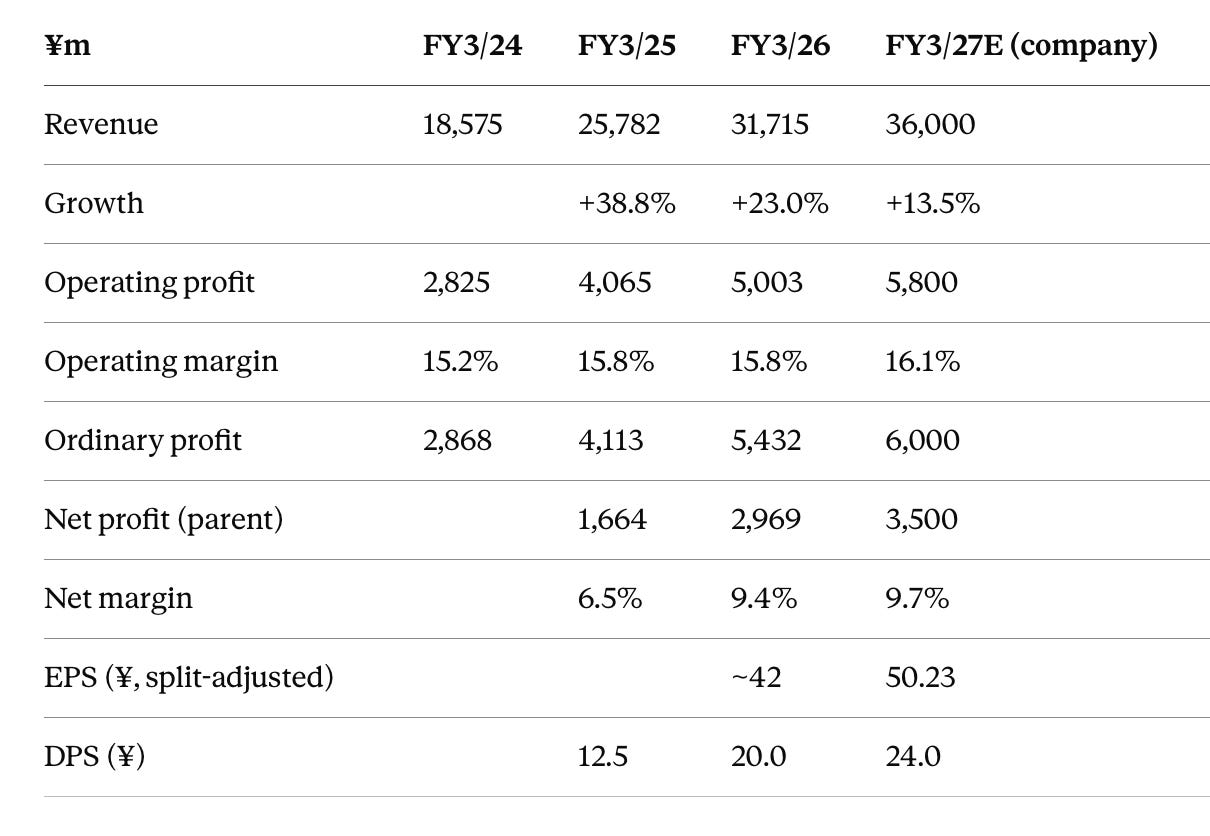
Revenue has grown at roughly 25% annually over three years. Operating profit has nearly doubled in two. The last fiscal year, ended March 2026, delivered revenue of ¥31.7bn (+23.0%), operating profit of ¥5.0bn (+23.1%), ordinary profit of ¥5.4bn (+32.1%) and net profit of ¥2.97bn (+78.4%) — the seventh consecutive record profit and the eighth consecutive year of higher revenue and earnings. Within that, the fan site business grew 27.0% to ¥24.6bn, driven by existing clubs, new club launches for large artists and a rising number of overseas members. E-commerce grew 8.8% and electronic ticketing continued to expand.
On margins, three things are worth separating.
Operating margin is stable at around 16% and guided slightly higher. It does not expand dramatically, and I do not model it doing so, because of the accounting shift I mentioned: as products like Fanpla Chance move to gross revenue recognition with royalties in cost of sales, the reported margin percentage falls even as the absolute profit rises. Investors who look only at the ratio will misread this business.
EBITDA margin is barely different from the operating margin. Depreciation and amortisation ran at ¥53m in the last quarter, so roughly ¥0.2bn a year against ¥5bn of operating profit. EBITDA of about ¥5.2bn on ¥31.7bn of revenue is a 16.5% margin. This is an asset-light platform where operating profit is very close to cash.
Return on equity is 34.7%, with a price-to-book of 6.8. Part of that is genuine capital efficiency and part of it is structural: equity is deliberately small because the business is financed by customer float. The equity ratio of 27.2% looks weak until you see what the liabilities are. There is no interest-bearing debt at all. The liability side is ¥9.5bn of trade payables (money owed onward to artists and agencies) and ¥8.3bn of contract liabilities (subscriptions collected in advance). Against that sits ¥15.3bn of cash and deposits plus ¥3.8bn of investment securities. This is a negative-working-capital model where fans pay first, which is exactly the balance sheet you want. I would still discount the headline cash: a meaningful part of it is float that will be paid out to rights holders, so I treat perhaps half of it as genuinely surplus.
Recent developments. The most recent quarter, the three months to June 2026 reported on August 14, showed revenue of ¥9.0bn (+21.6%), operating profit of ¥1.61bn (+15.8%) and ordinary profit of ¥1.71bn (+21.1%). The content segment grew 22.5% with segment profit up 21.5%; ticketing grew 17.1% with segment profit up 21.8%, helped by strong growth in sports and non-music events. Net profit attributable to the parent fell 22.4% to ¥666m, and that headline is the single most important thing to understand about the current share price. It was caused by a ¥402m extraordinary loss on the redemption of investment securities — a one-off, unrelated to operations, on a portfolio that in my view has no business being on this balance sheet in the first place. Strip it out and net profit rose in line with the rest of the P&L. Full-year guidance was left unchanged.
5. Valuation: what a fair multiple looks like
At ¥843, the shares trade at 16.8 times the company’s own EPS guidance of ¥50.23 for the year to March 2027. Adjust for the one-off securities loss, and the underlying multiple is closer to 15. Strip out the surplus cash and it is lower still. That is the entry price for a business growing revenue at 20%+, converting at a 35% return on equity, with no debt and an eight-year unbroken record.
My fair P/E for m-up is 24. I get there from three inputs: a durable growth rate around 20%, capital efficiency in the top decile of Japanese small caps, and revenue quality that is subscription-led and domestically insulated. Against that I discount for artist concentration, the royalty leverage of the biggest IP owners, minority interests taking roughly 15% of group profit, and investor relations that need work. Twenty-four is a demanding but not heroic multiple — it is a PEG of about 1.2 on a business earning 35% on equity, and it is roughly where the Japanese market prices proven recurring-revenue compounders once they are discovered.
The earnings path I underwrite:
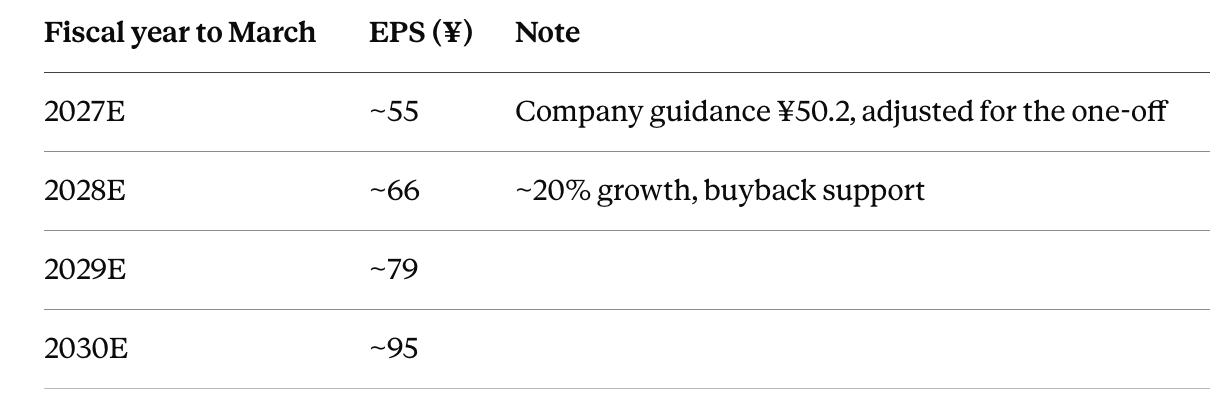
Three years from today the market will be looking at earnings power of roughly ¥95 per share. At a fair P/E of 24 that is a share price of about ¥2,280. From ¥843, that is a compound annual return of about 39% on the price, plus a dividend yield starting near 3% and rising with the payout. Call it 40% per year for three years.
The scenarios matter more than the point estimate:
Bear (~10% p.a.): growth decelerates to low double digits as a major artist relationship is lost or repriced, the multiple never leaves 15. EPS around ¥77 in FY3/30, share price ¥1,160.
Base (~40% p.a.): the model above. Growth holds near 20%, the multiple normalises to 24.
Bull (~50%+ p.a.): overseas fan clubs scale on the back of the IP360 programme, the buyback continues, EPS reaches ¥105 and the market pays 28 times for a company it has decided is a platform rather than a Japanese small cap.
Two thirds of the base-case return comes from earnings, one third from the re-rating. I am comfortable with that split. A case that requires the multiple to do all the work is a case I do not take.
6. Risks, and why this opportunity exists
A stock does not trade at 16 times earnings while growing at 20% for no reason. Here is what the market is worried about, and where I disagree.
The guidance blackout. When m-up reported record full-year results on May 15, 2026, it declined to publish any forecast for the current fiscal year, saying it could not reasonably calculate one. In a market where retail investors anchor on company guidance, that was read as a warning. The shares fell 8.8% in a day and kept falling to ¥590 by May 28, down 37% from the January high of ¥935. Management published the guidance on June 26 — revenue ¥36bn, operating profit ¥5.8bn, net profit ¥3.5bn, all up double digits — and the shares have been recovering since. This was a self-inflicted wound rather than a business problem, and it is the primary reason the entry price is what it is today.
The optics of the last quarter. A headline that reads “net profit down 22%” gets a small cap sold by screens and by investors who do not read to the extraordinary items line. The core business grew over 20%.
Artist concentration and royalty leverage. The genuine long-term risk. The company already showed that a single very large fan community can grow membership sharply while contributing much less profit than the average. If the biggest IP owners systematically renegotiate, growth continues and margins compress. I watch the gap between fan site revenue growth and content segment profit growth every quarter for exactly this reason.
A balance sheet with a question mark. ¥3.8bn of investment securities, and a ¥402m loss on redeeming some of them, is capital that should either be in the operating business or returned to shareholders. I would rather see the buyback extended than a securities portfolio managed.
Minority interests. Roughly 15–17% of group net profit belongs to non-controlling shareholders of the subsidiaries. Group-level figures overstate what accrues to m-up owners, and any calculation that ignores it overstates value.
Competition and platform risk. Weverse, Dear U’s own app and domestic rivals all want this market. The partnership with Dear U converts one competitor into a supplier, but it also means part of the fastest-growing product line depends on a Korean partner’s platform.
Key person and liquidity. Mito is 67 and central to the industry relationships that constitute the moat. Succession is undiscussed. Daily turnover is a few hundred million yen, which is fine for a fund of my size and not fine for everybody.
7. Latest news and where the numbers stand
The last twelve months, in order:
January 1, 2026: two-for-one stock split.
February 20, 2026: buyback resolution, 708,200 shares subsequently repurchased.
May 15, 2026: FY3/26 results. Eighth consecutive year of growth, seventh consecutive record profit, dividend raised to ¥20 and guided to ¥24. No forecast published. The shares fall to a low of ¥590 on May 28.
June 26, 2026: FY3/27 guidance published (revenue ¥36bn, +13.5%; operating profit ¥5.8bn, +15.9%; net profit ¥3.5bn, +17.9%). On the same day, Fanplus is selected under METI’s IP360 content industry growth investment programme, with a subsidy granted for the overseas expansion of its fan club model.
July 29, 2026: disposal of treasury shares as restricted stock compensation completed.
August 14, 2026: Q1 FY3/27. Revenue +21.6%, operating profit +15.8%, ordinary profit +21.1%, net profit −22.4% on the ¥402m securities redemption loss. Guidance unchanged.
Sentiment among Japanese retail investors has followed the same arc. The forums after the May results were full of anger that a company with record earnings would refuse to give a forecast, with several posters noting that withholding guidance is what companies did in the early pandemic or after the invasion of Ukraine, not after a record year. After the June guidance and the Q1 report, the tone shifted to a fairly accurate summary: an irritating one-off loss, and a core business that is firing on all cylinders. I share both halves of that assessment.
Watch items from here: the interim report in November, where I want to see the first-quarter growth rate sustained and the content segment margin holding; the overseas member number as the IP360 project ramps; and any signal on capital returns once the current buyback is exhausted.
8. Conclusion
m-up Holdings is the kind of business I want to own for a long time and the kind of stock the market rarely lets you buy cheaply for a good reason.
The investment case rests on four legs. First, a recurring-revenue model with near-zero customer acquisition cost, where the artist pays for the marketing and m-up collects the subscription. Second, switching costs at the artist and agency level that have produced eight consecutive years of growth without a single stumble. Third, a domestic Japanese end market at record highs that has been designated a strategic export industry, with the company’s main subsidiary now formally inside the government’s IP360 support programme. Fourth, a founder-CEO with 11.79% of the stock who is raising the dividend, buying back shares and pruning non-core businesses.
The price exists because of a communication failure in May, a cosmetic profit decline in August, and the general invisibility of a ¥61bn Japanese small cap with no analyst coverage and no earnings call. None of those three things affects the earnings power of the business in 2030.
There are two ways this works. The base case is simply that the compounding continues: 20% earnings growth, a multiple that drifts toward 24 as more investors find the story, roughly 40% annually for three years. The second case is the one that would surprise people, and it is the one the IP360 selection points at. Japanese artists are being discovered globally through anime tie-ins, streaming and social media, and the piece of infrastructure that turns a foreign listener into a paying, recurring, high-ARPU member does not exist yet outside Japan. Fanplus has spent nine years building multilingual payments and overseas membership tiers for exactly that moment, and now has a US subsidiary and government money to attack it. If overseas fandom becomes a real second engine rather than a rounding error, the fair multiple I use here will look too conservative.
I hold m-up Holdings as a position in the Haas Invest4 Innovation Fund, sized as a satellite rather than a core holding, because the artist concentration risk is genuine and because I want the room to add if the market gives me another May.
Risk disclaimer and conflict of interest
This article is a personal opinion and analysis. It is expressly not investment advice, not a recommendation to buy or sell, and not an offer or solicitation of any kind. It does not take into account the financial situation, investment objectives or risk tolerance of any individual reader.
Equities carry the risk of total loss. Japanese small caps additionally carry currency risk against the euro, liquidity risk, and information risk arising from limited English-language disclosure. Figures used here are taken from the company’s own filings and publicly available market data as of September 9, 2026; share prices, forecasts and multiples change continuously. Forward-looking statements, including the earnings path and the fair P/E applied in section 5, are estimates and assumptions that may prove wrong. Past performance is not an indicator of future results.
Conflict of interest: m-up Holdings (TSE: 3661) is held as a position in the cost-efficient Haas Invest4 Innovation Fund (invest4.net), which I manage, and I may hold the stock privately. I therefore have a financial interest in the price development of this security. Please form your own opinion, do your own research, and consult a licensed adviser if you need one.
© investresearch.net – Philipp Haas
Thanks for this write up. My biggest concern is the investment securities on their balance sheet.
¥2,311m went into investment securities in FY3/2026 and the securities book has now produced ¥426m and ¥402m of redemption losses in consecutive periods, against cumulative securities losses of roughly ¥1.5bn since FY3/2025.
Putting aside the age old Japanese cross-shareholding issue, what do they have that has lost money for the past 9 months in Japan?
Every small artist can vibe code a Shopify fanclub website now.