

investresearch.net · 3 September 2026
Introduction: A Business Model I Wish Existed in Frankfurt
Every so often I look at a Japanese small cap and think: why on earth does this not exist in Europe? Digital Grid is one of those cases.
Picture the German or Spanish power market. On one side you have a farmer with a 5 MW solar park, a municipal utility with a wind farm, a corporate rooftop installation. On the other side you have a mid-sized manufacturer who wants clean electricity, wants it cheaper than the incumbent utility offers, and increasingly wants to prove to auditors exactly which electron came from where. Between them sits an oligopoly of large integrated utilities taking a spread that nobody can really see.
Digital Grid built the thing that removes that middleman. The Digital Grid Platform, or DGP, is a marketplace where generators and corporate consumers transact directly. Not a power producer. Not a retailer in the traditional sense. A matching engine, a settlement layer, and a risk-management brain sitting on top of Japan’s liberalised electricity market — and it earns a fee on every kilowatt-hour that flows across it.
The concept itself came out of Professor Rikiya Abe’s laboratory at the University of Tokyo in 2008, where the idea was that electricity could be digitally “colour-coded” and traded freely, like packets on the internet. In 2008 that sounded like science fiction, because Japan’s grid was a one-way street from large thermal and nuclear plants. Nearly two decades later, with rooftop solar everywhere and corporate decarbonisation reporting now a board-level obligation, the idea has become a real business with real cash flows. Abe is Chairman and CTO. The company was incorporated in 2017 and listed on the TSE Growth Market in April 2025.
Here is why I am writing about it today. The stock IPO’d at ¥4,520 (¥904 split-adjusted), roughly doubled into August 2025, and has since fallen more than 60% over twelve months, touching an all-time low of ¥666 on 11 June 2026. It closed on 2 September at ¥770, giving a market capitalisation of ¥32.2bn — around €174m or $199m. That is a smallercompany than it was at IPO, despite revenue having grown from ¥1.2bn in FY2022 to a guided ¥6.6bn this year and operating margins above 40%.
The stock trades at 15.9x this year’s company-guided earnings. I think the fair multiple for this asset is 24x. Combine that with the earnings growth the business is capable of delivering into fiscal 2029, and I get an annualised return potential of roughly 34%.
The catch — and there always is one — is that Digital Grid is having an awkward year. Volume is growing nicely; unit prices are not. That transition from hypergrowth to digestion is exactly what has broken the share price, and it is exactly why the opportunity exists.
1. Product, Business Model, Brand and Moat
What they actually do
The group reports three segments, and it is worth separating them properly because they are very different animals.
Electricity Platform (Power PF). The core. Corporates come to DGP to procure electricity; generators come to sell it. Digital Grid matches them, handles the wholesale market interface, and takes a usage fee tied to the volume transacted and the contracted capacity. Crucially, the company has built what it calls a tailor-made procurement model: a customer can blend a fixed-price tranche with a market-linked tranche to suit its own risk appetite, rather than being forced into one or the other. This is the fee engine and the majority of group profit.
Renewable Energy Platform. The higher-growth sibling. This covers renewable power traded across DGP plus the environmental-attribute layer: Econohashi, an agency service for buying non-fossil certificates and environmental value, and RE Bridge, a virtual PPA auction site where a corporate can effectively post a request for the kind of renewable generation it wants and let generators bid. In the first nine months of the current fiscal year this segment grew revenue 54.6% and more than doubled segment profit, up 113.5%.
Other — balancing power and education. Two things live here. The balancing-power (adjustment) business, where Digital Grid acts as an aggregator optimising grid-scale batteries, earning recurring fees; and GX Navi, a decarbonisation training service for companies starting their green-transformation journey. This segment turned profitable during the current year.
How the money is made
Fee-based, volume-linked, asset-light — with one important qualification. Because Digital Grid stands between the wholesale exchange and the end customer, it carries balancing-group responsibility: it must match planned and actual half-hourly volumes, and the difference settles as an imbalance charge or credit. That is a real P&L line, it moves around, and it is also the single biggest reason a competitor cannot simply clone the front-end and win.
Gross margin runs at roughly 79%. Contracted capacity stood at 1,034 MW at the end of fiscal 2025, up 29.4% year on year. The whole operation is run by around 79 employees. That combination — near-800 megawatts of contracted load per hundred staff — is what a genuine platform looks like.
Brand
Let me be honest about scale. This is not a consumer brand and it never will be. Digital Grid is known inside a specific Japanese ecosystem: corporate energy managers, sustainability officers, independent generators, and the GX policy community. Within that world the reputation is strong and getting stronger, helped by two things. First, Toshiba is the largest shareholder with roughly 12% — a strategic anchor that opens doors in an industry where a startup would otherwise be treated as an unserious counterparty. Second, the company has positioned itself early on the reporting side: when the GHG Protocol’s Scope 2 guidance moved towards hourly matching, Digital Grid was out in front with hourly visibility of renewable procurement. In a market where the buyer’s real problem is increasingly proving what they bought, that is brand-building of the most useful kind.
The retail investor community in Japan knows the name too, though for less flattering reasons this year — the discussion boards and the Japanese finance corner of X have been a mix of frustrated IPO buyers and value hunters, with sentiment recently tilting bullish again as the price stabilised in the high ¥700s.
Moat
I would rate this a genuine, narrow, deepening moat. Four planks:
Two-sided network effects. More generators means better prices and more choice for buyers, which pulls in more buyers, which makes the platform the obvious place for a generator to list. Contracted capacity compounding at ~30% is the evidence.
Imbalance risk management. Anyone can build a matching website. Very few can forecast demand and generation accurately enough, half-hour by half-hour, to avoid being bled dry by settlement charges. Digital Grid has pushed AI-based forecasting into production specifically to shrink this variance. This is the operational barrier.
Regulatory and operational plumbing. Licences, JEPX membership, credit lines, balancing-group status, system integrations. Slow and expensive to replicate.
Switching costs. A corporate that has built its Scope 2 reporting workflow around DGP data does not casually move.
What it is not is unassailable. The large incumbent utilities could compete on price if they chose to, and other aggregators exist. But they would be cannibalising their own retail margins to do it, which is the classic innovator’s dilemma that keeps a company like this alive long enough to matter.
2. Market: Big, Structurally Growing, Politically Exposed, Moderately Cyclical
Japan liberalised retail electricity in 2016. The entire national market is in the order of ¥20 trillion. Digital Grid’s revenue of ¥6.6bn against that number tells you the runway is essentially unlimited in mathematical terms — penetration is a rounding error.
Three structural drivers make me comfortable this is not a fad:
Decarbonisation is now mandatory, not optional. Japan’s latest energy plan pushes renewables towards 40–50% of the power mix by 2040, and the GX framework has made corporate emissions disclosure a normal part of doing business. Every large Japanese corporate now needs a renewable procurement strategy, and most of them do not want to build one themselves.
Distributed generation needs a distributed marketplace. As generation shifts from a handful of large plants to thousands of small ones, the coordination problem grows combinatorially. That is a software problem, not a turbine problem.
Intermittency creates a storage and balancing market from nothing. Grid-scale batteries in Japan are moving from pilot to build-out, and someone has to optimise them. Digital Grid is positioning as that someone.
On political interference I have to be candid: this is an infrastructure-adjacent, regulated market. Capacity market rules, feed-in structures, non-fossil certificate mechanics and grid tariffs all change by administrative decision. That is a permanent feature, not a passing risk. The offsetting point is that the direction of policy travel is strongly in Digital Grid’s favour — liberalisation and decarbonisation both increase the value of a neutral marketplace.
On cyclicality: less than you would fear, more than the company’s fee model suggests. Industrial electricity demand is reasonably defensive. But wholesale power prices are volatile, and — as this year has demonstrated — the unit priceDigital Grid earns per transaction moves with them. There is also clear intra-year seasonality: the August–October first quarter carries peak summer demand and is the strongest of the year, while the February–April third quarter is the seasonal trough. Management stated at the last quarterly Q&A that geopolitical tension and a fuel price spike would not derail the current outlook, since the model is largely insulated from directional wholesale price risk. I believe them at the operating level. I do not believe it protects the share price from sentiment.
3. Culture and Management: Founder Energy, Wall Street Discipline
CEO Yusuke Toyoda is 39. He started at Goldman Sachs Japan in 2012, moved to the private equity firm Integral in 2016, joined Digital Grid in February 2018 and took the CEO seat in July 2019 at the age of 32. He holds roughly 5.2%of the company.
That biography matters more than it usually does. This is a business whose central operational challenge is managing a book of forward power positions and imbalance exposure while extending working capital to customers — genuinely a trading and risk job wrapped in a software skin. Having a former investment banker with buyout-firm experience running it is a better fit than a pure engineer would be. And Abe, the academic who invented the concept, remains as Chairman and CTO, so the technical vision has not been diluted.
The stated mission is the “democratisation of energy” — connecting a world without energy constraints to the next generation. The internal values are, charmingly, Be on the Edge, Far Together and Stay Gold. Make of that what you will; I read it as a startup that has not yet been institutionalised into blandness.
On strategy, the medium-term plan through fiscal 2028 is unusually specific for a Japanese small cap and unusually shareholder-oriented:
ROE sustained above 20%
Operating margin sustained above 40%
CAGR in total electricity handled above 30%
¥10bn invested in storage batteries over three years, targeting 40 MW by FY2028
Toyoda has also publicly stated an aspiration to reach a ¥100bn market capitalisation. Against today’s ¥32bn, that is a triple, and I generally like managers who name a number in public and then have to live with it.
The one thing I would flag on capital allocation: the battery build-out is a deliberate move away from asset-light. Management is spending real capex to own balancing assets rather than only aggregate third-party ones. I think this is defensible — it secures a position in a market that is forming right now — but it changes the character of the balance sheet, and it deserves monitoring rather than applause.
4. Financials, Margins and Recent Developments
The growth record
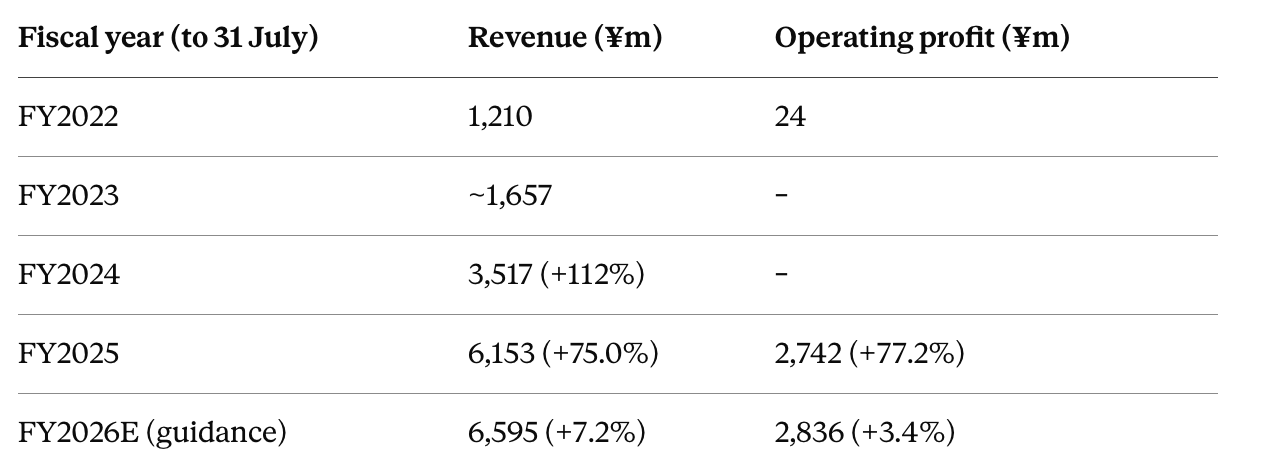
Five times revenue in four years, with operating profit going from essentially zero to ¥2.7bn. That is the track record the market fell in love with in 2025.
Then look at the last column and you see the problem. Growth has decelerated sharply. This is the single most important fact about the stock right now, and it deserves an honest explanation rather than a dismissal.
What is actually happening under the surface
The deceleration is a price effect, not a demand effect. In the fourth quarter of FY2025 the per-transaction usage fee dropped 17.7% year on year, and management guided the current year on the assumption that average unit prices would keep falling even as handled volume rose more than 20%. The original FY2026 guidance therefore called for a 13.8% decline in operating profit — which is precisely the moment the market stopped paying a growth multiple.
The nine-month results published on 11 June 2026 told a better story: revenue of ¥5,107m (+6.6%) and operating profit of ¥2,447m (+3.1%), with the renewable platform up 54.6% and the other segment swinging into profit. Good enough that management raised full-year guidance on the same day:
Revenue: ¥6,281m → ¥6,595m (+5.0% vs prior guidance)
Operating profit: ¥2,363m → ¥2,836m (+20.0%)
Ordinary profit: ¥2,128m → ¥2,660m (+25.0%)
Net profit: ¥1,476m → ¥1,919m (+30.0%)
So the year that was supposed to see profits fall 14% will now see them rise. That is a materially different picture from the one priced in.
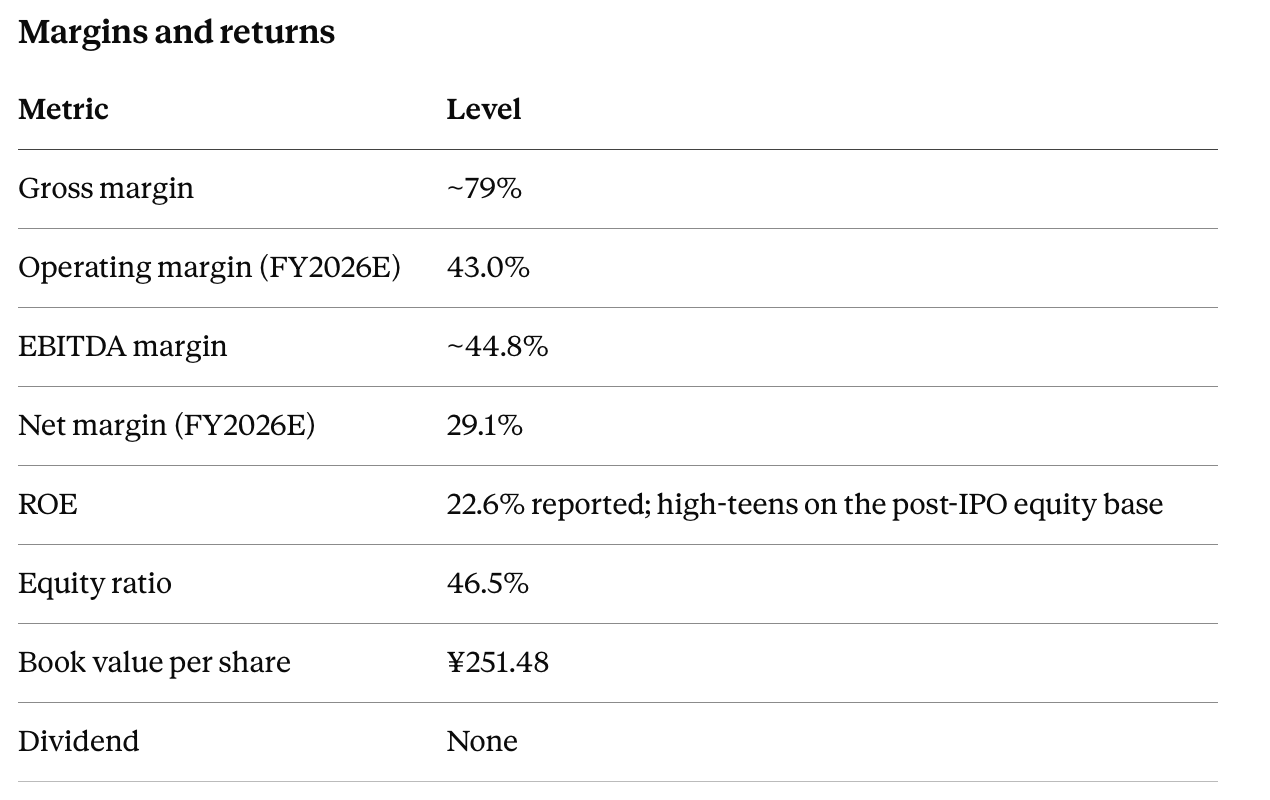
These are software margins on an energy revenue line. A 43% operating margin on a business that intermediates physical electricity is remarkable, and it is the clearest evidence that the fee model is genuinely platform economics rather than a repackaged utility.
The balance sheet holds more cash than debt, which is important given the structural working capital drag: Digital Grid pays JEPX before it collects from customers, so growth consumes cash. Management has arranged committed credit facilities with multiple banks specifically to handle this. Those facilities carry net-asset covenants, which is worth knowing.
Recent developments
Three moves in the last few months tell you where this is going:
1 July 2026 — entry into the low-voltage corporate segment, with a dedicated subsidiary, DG Life, established to run it. This widens the addressable customer base from large industrial accounts down to smaller businesses across the whole country.
7 August 2026 — a new matching service for grid-scale storage assets, extending trading support to batteries from the development stage through to operation.
June 2026 — an upgrade to RE Bridge letting corporate buyers post specifications for the renewable generation they want, plus a response to the revised GHG Protocol Scope 2 standard giving hour-by-hour visibility of renewable procurement.
Meanwhile the first grid-scale battery facility is already operating, with the bulk of storage revenue expected to arrive in fiscal 2027 and 2028. The balancing business runs on proprietary automation and a cross-manufacturer battery gateway — meaning Digital Grid can manage assets regardless of who built the battery, which is precisely the right architecture for an aggregator.
5. Valuation: A Fair PE of 24 and 34% Annually
My valuation approach here is the one I use across the portfolio: establish what the business should earn three years out, apply a defensible normalised multiple, and let the implied annual return decide whether the stock is interesting.
Where we start. At ¥770, with company-guided EPS of ¥48.41 for the year ending July 2026, the stock trades at 15.9x. Price to book is 3.06x. There is no dividend.
What the fair multiple should be. I set the fair PE at 24x. My reasoning:
A two-sided marketplace with 79% gross margins, 43% operating margins and a high-teens-to-low-twenties ROE would attract 30x or more in almost any Western market.
Revenue quality is high and recurring in character — contracted capacity, not one-off projects.
Against that, I discount for genuine unit-price volatility, regulatory dependency, single-country exposure, a working-capital-hungry model, and a TSE Growth listing with essentially no sell-side coverage.
24x is roughly a 50% premium to the Japanese small-cap average and a meaningful discount to what a comparable Western platform would fetch. It is a multiple I would be comfortable defending in a drawdown.
The earnings bridge. To justify a 34% annual return over three years I need EPS to compound at roughly 17% per annum from ¥48.41 in FY2026 to about ¥77 in FY2029. Given that management is targeting more than 30% annual growth in electricity handled through FY2028, that the renewable platform is compounding at 50%+, that storage revenue is only scheduled to arrive from FY2027, and that the low-voltage market has just opened, 17% strikes me as the conservative case rather than the aggressive one. It assumes unit prices keep grinding lower and volume does the heavy lifting.
The result:
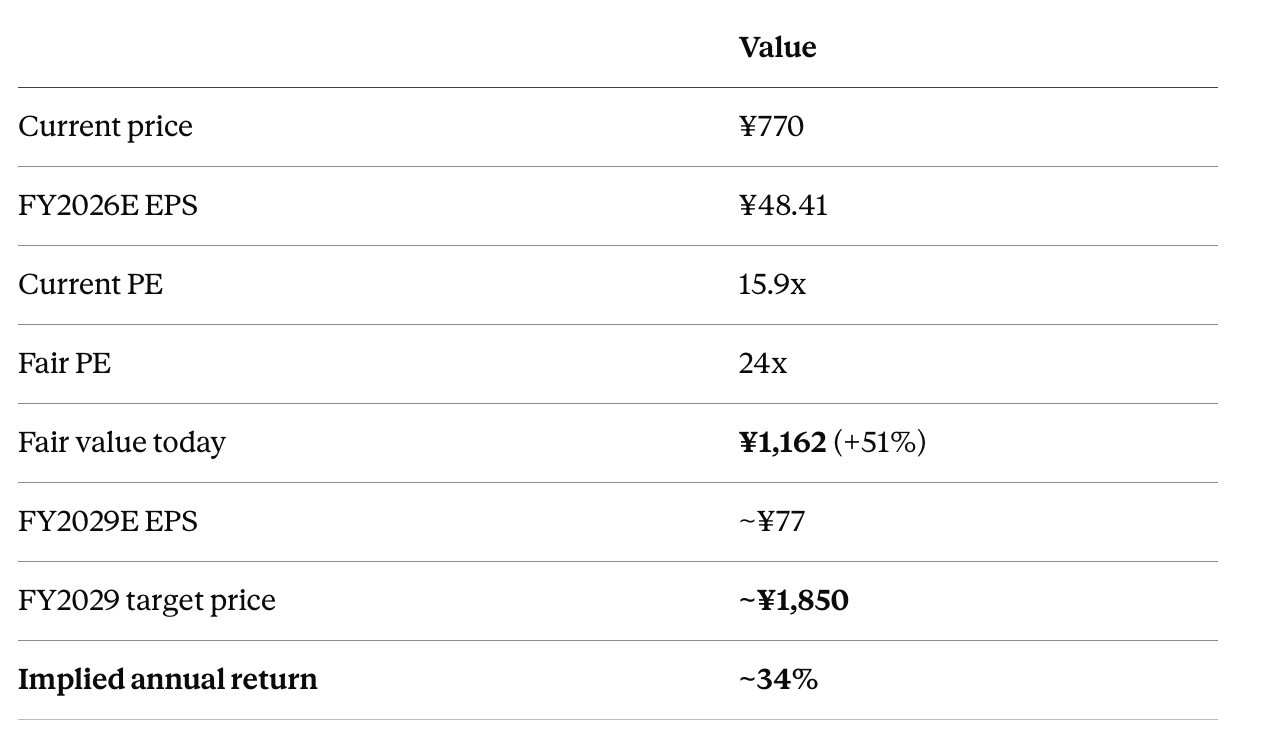
Two sensitivities worth holding in mind. If the market never re-rates and the stock stays permanently at 16x, I still earn the 17% earnings growth — a perfectly respectable outcome, and my downside case. And if this becomes a hype stock again — which it demonstrably can, given it traded above ¥2,000 thirteen months ago — a 30x multiple on ¥77 puts the shares near ¥2,300, or something close to 44% annually. I do not underwrite that outcome. I simply note that the distribution is skewed to the upside.
6. Risks: Why the Price Fell and Why the Opportunity Exists
The share price chart is brutal and it deserves a proper explanation, because if I cannot explain the decline I have no business claiming the market is wrong.
The IPO was priced for perfection and then some. Listing in April 2025 into a market that loved Japanese growth stories, the shares roughly doubled by mid-August 2025. At the peak, investors were paying a very large multiple for a company that had just grown revenue 75%.
The FY2025 results were the turning point. On 11 September 2025 the company reported a superb year — and simultaneously guided the next one to a 13.8% profit decline on falling unit prices. Growth investors do not tolerate that. The de-rating started that day and ran for nine months, bottoming at ¥666 on 11 June 2026. The day after the raised guidance, the stock went limit-up 14.35%. That is a shareholder register in transition, violently.
Retail leverage is still an overhang. The margin buy balance stands at roughly 2.48m shares against 41.8m outstanding, a margin ratio above 6x. Every rally meets sellers who bought higher and financed the position. This mechanically caps rallies until the balance works down.
No coverage, no institutions. The stock is formally uncovered by analysts. Roughly 71% of the register sits with retail and non-institutional holders. There is no natural buyer to arbitrage a valuation gap.
Now the fundamental risks, which are the ones that actually matter for a three-year holding period. Management’s own disclosure is refreshingly direct, and I would highlight these:
Unit price and churn risk. If wholesale prices spike, customers on fully market-linked plans get hurt and may renegotiate or leave. Fee income falls and retention spending rises.
Imbalance settlement volatility. Forecast error translates directly into P&L swings and cash flow noise. This is the operational heart of the business.
Working capital and funding. Payments to JEPX precede customer collections. Growth burns cash. If credit lines tighten, growth is constrained.
Covenant sensitivity. The committed facilities require minimum net asset levels; a bad year plus heavy battery capex could reduce financial flexibility at the worst moment.
Regulatory change. Capacity market design, certificate mechanics and system reform all evolve. Each change means system rework and possible margin impact.
Single-platform technology risk. DGP is self-developed. A serious outage, bug or cyber incident would be a direct hit to trading continuity and reputation.
Battery execution. ¥10bn is a lot of capex for a company this size. Delays or disappointing returns would push out the FY2027–28 revenue contribution the plan depends on.
Revenue concentration. The Electricity PF fee stream still dominates group profit. If it stalls, the other segments cannot yet compensate.
The honest summary: this is a good business going through a price-mix reset, owned by a shareholder base that bought it as a momentum story and is still liquidating. Those two things together produced a 60% drawdown in a company whose profits are now guided up. That gap between narrative and numbers is where the return lives.
7. Latest News and Earnings
The most recent reported numbers are the third-quarter figures from 11 June 2026 covering the nine months to 30 April: revenue ¥5,107m (+6.6%), operating profit ¥2,447m (+3.1%), with the renewable platform up 54.6% on revenue and 113.5% on segment profit, and the other segment turning positive. Full-year guidance was raised the same day to ¥6,595m revenue, ¥2,836m operating profit and ¥1,919m net profit.
The accompanying investor Q&A was, to my eye, the most reassuring document the company has published since listing. Management addressed the geopolitical and fuel-price question head on and argued that the model is largely insulated from directional wholesale price risk. They reported surging interest in the tailor-made procurement structure that blends fixed and market-linked supply — which is exactly the product you would want to be selling into a volatile price environment, because it converts customer anxiety into a reason to use the platform rather than a reason to leave it.
They also confirmed the storage roadmap: ¥10bn towards 40 MW by fiscal 2028, first grid-scale facility already live, meaningful revenue from fiscal 2027–2028, and a balancing business built on proprietary automation plus a cross-manufacturer gateway.
Since then, the flow of announcements has been steady rather than dramatic: the low-voltage corporate launch and the DG Life subsidiary from 1 July, the grid-scale storage matching service on 7 August, the RE Bridge functionality upgrade, and the Scope 2 hourly-matching response.
The near-term catalyst is one week away. Full-year results for the year ending July 2026 are scheduled for 10 September 2026. Two things matter in that release: whether the raised guidance was met or beaten, and — far more important — what management guides for fiscal 2027. Last year’s guidance day was the moment the stock broke. This year’s is the moment it could stop being broken, particularly if the FY2027 outlook reflects the low-voltage expansion and the first real storage contribution. I would rather own this into that print than after it.
The shares closed at ¥770 on 2 September, down 3.4% on the day and drifting on modest volume, with the year-to-date range running from ¥666 to ¥1,050.
8. Conclusion: What Has to Go Right
Digital Grid is the cleanest expression I have found of an idea I keep returning to — that the energy transition will be won as much by software that coordinates electrons as by hardware that generates them. It is a marketplace with network effects, 79% gross margins, 43% operating margins, a founder-adjacent CEO with real skin in the game, a strategic anchor shareholder in Toshiba, and a three-year plan with numbers attached to it.
It trades at 15.9x earnings because it had one difficult year on pricing and because its post-IPO shareholder register has been unwinding for twelve months. Those are real problems. Neither of them is a problem with the business.
I see three ways this works:
The base case — the deceleration was temporary. Volume compounds at the 20–30% management is targeting, unit prices stabilise, and earnings grow around 17% annually. The multiple drifts back toward 24x as the growth-scare narrative fades. That is roughly 34% per year and it is the case I underwrite.
The storage case — a second engine appears. The ¥10bn battery programme and the aggregation business deliver from fiscal 2027, adding a recurring-fee revenue stream that is structurally less exposed to platform unit-price pressure. Earnings growth reaccelerates above my assumption and the multiple expands because the business looks more durable. This is the case where the fair PE I have used turns out to be too low.
The hype case — a small cap in a hot theme. Japanese grid-scale storage and AI-driven power demand are exactly the kind of themes that produce violent re-ratings in a 41-million-share float with a 6x margin ratio. The stock traded above ¥2,000 in August 2025 on worse fundamentals than it has today. I do not model this and I would be selling into it, but it is a real feature of the risk-reward.
The bear case is equally clear: unit prices keep compressing faster than volume grows, imbalance losses widen in a volatile market, the battery capex disappoints, and this settles as a 15x business growing at single digits. In that scenario I lose time rather than a great deal of capital — the balance sheet is sound, cash exceeds debt, and the company is profitable throughout.
What has to go right is not complicated. Volume has to keep compounding, and management has to stop the price line falling faster than the volume line rises. The nine-month numbers and the June guidance raise say they are winning that fight. The share price says nobody has noticed. On 10 September we find out who is right.
Risk Disclaimer
This article reflects my personal opinion and is intended for information and educational purposes only. It is not investment advice, not a recommendation to buy or sell any security, and not an offer or solicitation of any kind. Nothing here takes account of your individual circumstances, objectives, financial situation or risk tolerance.
Equity investing involves substantial risk, including the total loss of capital. Small caps listed on the TSE Growth Market are illiquid, volatile and can move violently on single news items. Digital Grid in particular has fallen more than 60% over the past twelve months and carries elevated business risk from power price volatility, imbalance settlement exposure, working capital intensity, financial covenants, regulatory change, technology dependency, execution risk on its battery investment programme and revenue concentration in a single segment. Investors outside Japan additionally bear yen currency risk and higher transaction costs.
All figures are drawn from company disclosure and publicly available market data as of 3 September 2026 and may contain errors or become outdated without notice. Forward-looking statements, projections, target prices and return estimates are assumptions, not forecasts and certainly not promises. Past performance is no indicator of future results.
Conflict of interest disclosure: Digital Grid Corporation (TSE: 350A) is a holding in the cost-efficient Haas Invest4 Innovation Fund (invest4.net), which I manage. I therefore have a financial interest in the security discussed and may buy or sell it at any time without notice or updating this article. Please form your own view and consult a licensed adviser before making any investment decision.
Philipp Haas · investresearch.net